How a Security Operations Center Prevents Cyber Attacks

Cyber attacks are becoming more sophisticated, frequent, and difficult for businesses to detect. Traditional security tools such as firewalls and antivirus software remain important, but they are often not enough to identify modern threats quickly. Businesses need continuous visibility into their IT environments and the ability to respond when suspicious activity occurs.
This is where a Security Operations Center (SOC) plays an important role.
A Security Operations Center brings together cybersecurity professionals, advanced monitoring technologies, threat intelligence, and incident response processes to continuously monitor an organization's digital environment. For businesses that do not want to build and maintain an internal security team, Managed SOC Services provide access to these capabilities through an experienced cybersecurity provider.
What Is a Security Operations Center?
A Security Operations Center is a centralized function responsible for monitoring, detecting, investigating, and responding to cybersecurity threats.
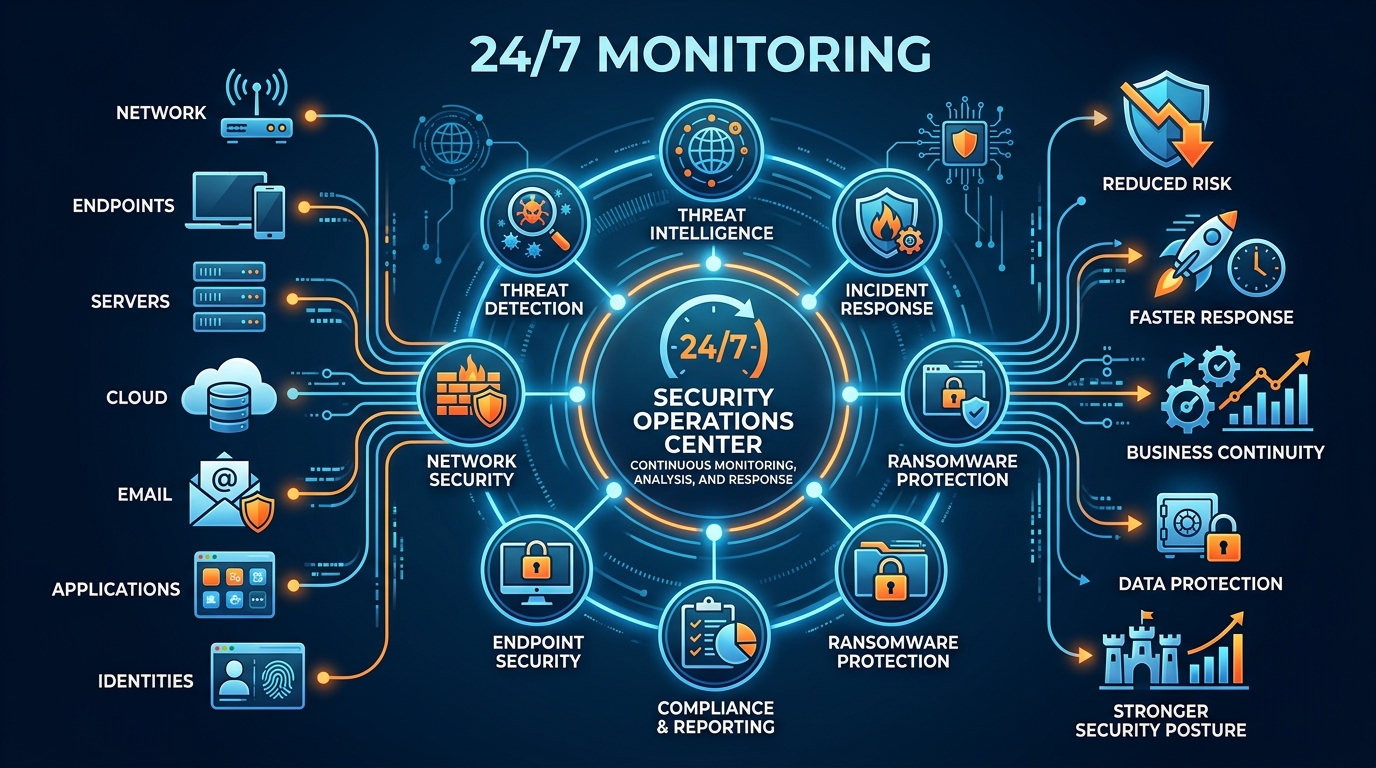
A SOC can monitor multiple parts of an organization's technology environment, including:
- Networks and firewalls
- Servers and endpoints
- Cloud infrastructure
- Email systems
- Business applications
- User identities and access
- Remote devices
Modern SOC environments combine continuous monitoring with threat intelligence, automation, behavioral analytics, and security expertise to identify unusual activity and potential attacks.
Professional Labs provides 24/7 Managed SOC Services designed to monitor endpoints, networks, servers, cloud platforms, and email systems while helping organizations detect and respond to evolving cyber threats.
How Does a Security Operations Center Prevent Cyber Attacks?
1. Continuous Security Monitoring
Cyber attacks can happen at any time, including nights, weekends, and holidays. A Security Operations Center provides 24/7 security monitoring, allowing suspicious activity to be investigated even when an organization's internal IT team is unavailable.
Continuous monitoring helps identify unusual login activity, unauthorized access attempts, malware behavior, and other indicators of compromise.
2. Real-Time Threat Detection
A modern SOC uses security analytics, threat intelligence, and behavioral analysis to identify potential threats.
For example, an employee account suddenly accessing systems from an unusual location or attempting to access large amounts of sensitive data could trigger a security alert.
Professional Labs uses AI-powered detection and behavioral analytics as part of its Managed SOC approach to help identify known and emerging threats.
3. Faster Incident Response
Detecting a threat is only the first step. Businesses also need to respond quickly.
A Security Operations Center investigates alerts and helps determine whether an event is a genuine security incident. When necessary, response actions can help contain the threat and reduce its impact on business operations.
Faster incident response can help organizations reduce downtime, limit potential data exposure, and minimize the financial impact of cybersecurity incidents.
4. Threat Intelligence
Cybersecurity teams continuously track information about emerging threats, attack techniques, malicious infrastructure, and vulnerabilities.
This threat intelligence helps security teams understand how attackers operate and improve detection capabilities.
Professional Labs incorporates continuous threat intelligence gathering and analysis into its Managed SOC services.
5. Protection Against Advanced Threats
Modern businesses face threats such as ransomware, phishing, credential theft, and Advanced Persistent Threats (APTs).
A Security Operations Center provides a centralized approach to identifying suspicious activity across different systems rather than relying on individual security tools.
This becomes particularly important for organizations operating hybrid IT environments involving cloud services, remote employees, endpoints, and traditional infrastructure.
Why Choose Managed SOC Services?
Building an internal Security Operations Center requires cybersecurity professionals, security platforms, monitoring infrastructure, threat intelligence, and continuous training.
Managed SOC Services allow businesses to access these capabilities without having to build an entire SOC internally.
Professional Labs operates as a managed security service provider (MSSP), offering 24/7 monitoring, threat detection, incident response, threat intelligence, MDR, XDR, and vulnerability assessment capabilities.
This approach can be particularly valuable for organizations that need stronger cybersecurity protection but have limited internal security resources.
Security Operations Center and Compliance
Cybersecurity monitoring can also support organizations working toward regulatory and security requirements.
Professional Labs' Managed SOC services support security and compliance requirements associated with frameworks and standards including HIPAA, PCI DSS, ISO 27001, and SOC 2.
A strong SOC strategy can therefore contribute not only to threat prevention but also to an organization's broader security and risk management program.
Protect Your Business With 24/7 SOC Monitoring
Cybersecurity is no longer something businesses can address only after an incident occurs. A proactive Security Operations Center provides continuous visibility, threat detection, intelligence, and incident response to help organizations stay ahead of evolving cyber risks.
For businesses that want access to experienced cybersecurity professionals without the complexity of building an internal SOC, Managed SOC Services can provide a scalable solution.
Professional Labs provides 24/7 Managed SOC Services focused on monitoring, detecting, and responding to cybersecurity threats across modern IT environments.
Learn more: Professional Labs Managed SOC Services
Explore Professional Labs' IT and Cybersecurity Services: Professional Labs